Isan: The Thailand Most Tourists Never See
Isan Thailand: Most people who visit Thailand see the same Thailand. Bangkok’s temples and rooftop bars. The beaches of Koh Samui or Phuket. Chiang Mai’s Sunday market and elephant sanctuaries. It’s all genuinely good. None of it is the Thailand that most Thai people actually live in.
Northeast Thailand — Isan — is where that other Thailand exists. Twenty provinces. A third of the country’s land area. A third of its population. One of the world’s great rivers forming its northern and eastern border. Almost zero international tourists.
I know this because I live here.
When I arrived in Isan for the first time, the contrast with Bangkok and Pattaya was immediate. The bright lights and constant noise gave way to something quieter and more deliberate.
Village life in a small Isan community is something you need to experience firsthand. It starts before dawn — loudspeakers at 5am carrying monks’ chants across the village, and residents sitting by the roadside to offer food as the monks pass on their morning round. Then the midday quiet as the temperature climbs and daily life retreats indoors. Then the evenings, when people return from work to sit with their families, eat together and talk about the day. By 8pm the village is still. Just the crickets and frogs calling, and the occasional dog howling somewhere in the distance. As a Westerner, you won’t find peace and quiet quite like it anywhere.
My wife is from a small village in Isan Thailand. We’ve made our home in Roi Et, in the northeast, about eight hours from Bangkok and one hour from the Laos border. I’ve watched this region from the inside — the morning markets before dawn, the rice fields turning gold in November, the Mekong running full and brown in the rainy season, the festivals that draw Thai people from across the country while barely registering on any international travel calendar. What follows is not a guide in the traditional sense. It’s an honest account of why Isan deserves more attention than it gets, and what you’ll find when you come.
The Thailand That Got Left Behind
Understanding Isan requires understanding something about how Thai tourism developed. When international visitors started arriving in serious numbers in the 1980s and 90s, they came for beaches and temples. Infrastructure followed demand. Phuket got an international airport and luxury resorts. Chiang Mai got boutique hotels and trekking agencies. Bangkok got everything. Isan, which has none of the beaches and whose temples are remarkable but less photogenic than Wat Pho or Doi Suthep, was largely bypassed.
The result is a region where daily life has remained almost entirely unmodified by tourism. The markets exist because local people need them, not because visitors want to photograph them. The restaurants serve what Isan people eat, not what guidebooks say foreigners will find approachable. The prices are what things actually cost in provincial Thailand, not what the market will bear from someone on a two-week holiday.
When you arrive in Udon Thani or Khon Kaen and walk into a morning market at 6am, you are not a participant in a curated cultural experience. You are just a person in a market, slightly conspicuous, surrounded by people buying their breakfast and their groceries and getting on with their day. That distinction matters more than it might initially seem.
The Mekong
No single feature defines Isan more than the Mekong River. It forms the entire northern and northeastern boundary of the region — 1,000 kilometers of one of the world’s great rivers, running from Tibet through China and Myanmar before reaching Thailand, forming the border with Laos, and continuing south through Cambodia and Vietnam to the sea.
Nong Khai
The Mekong at Nong Khai, 55 kilometers north of Udon Thani, does not look like a tourist attraction. There are no organised boat trips, no riverside cocktail bars competing for sunset views.
There is a long promenade, some plastic chairs, a few restaurants facing the water and, across the river, the gentle hills of Laos catching the last light of the afternoon. It is one of the most quietly extraordinary views in Southeast Asia and almost nobody outside Thailand has heard of it.
Ork Phansa
In October, on the night of Ork Phansa — the end of Buddhist Lent — something happens on the Nong Khai stretch of the Mekong that has been documented, filmed and debated for decades without being satisfactorily explained. Glowing balls of light rise from the river surface and float silently upward before disappearing.
Naga fireballs
Hundreds. Sometimes thousands. Thai Buddhists believe they are Naga fireballs, a sign from the sacred serpent of the Mekong. Scientists have proposed various theories, none of them settled. Standing on the bank with thousands of Thais watching in reverent silence, the explanation feels less important than the fact of it.
Mekong river towns
The Mekong towns — Nong Khai, Mukdahan, Nakhon Phanom, That Phanom — each have this quality of being genuinely themselves rather than a version of themselves constructed for visitors. Nakhon Phanom has French colonial-era buildings from the period when this stretch of the Mekong marked the boundary between Siam and French Indochina.
That Phanom has Wat Phra That Phanom, one of the most revered Buddhist temples in the country, where the faithful come from across Isan and Laos to offer lotus flowers at dawn. Mukdahan faces Savannakhet across the river and has a market where Lao, Vietnamese and Thai goods sit side by side.
None of these places are on any international tourist circuit. All of them are worth the journey.
The Food
If you have eaten Thai food anywhere in the world, you have probably eaten Isan food without knowing it. Som tam — papaya salad — is from here. Larb — minced meat salad with toasted rice powder and herbs — is from here. Gai yang, the charcoal-grilled chicken that scents the air outside every market in Thailand, is from here. Sticky rice, eaten with the hands rather than a spoon, is from here.
Street Food
The street food of Isan fed migrant workers who came south to Bangkok for decades, and with them came their cooking. What you eat at a Bangkok street stall is frequently a softened, slightly sweetened adaptation of something that tastes sharper and fiercer at its source.
Som Tam
Eating som tam in Khon Kaen is a different experience from eating it in Bangkok. The papaya is shredded finer. The lime is more present. The fermented fish sauce — pla ra — adds a depth of flavor that the tourist-area version usually leaves out. The chilli is not adjusted for anyone’s comfort. You are eating the dish as it was designed, not as it has been translated.
Morning Markets
The morning markets of Isan operate from around 5:30am until 9am and contain the most honest food in the country. Sai krok — fermented pork sausages grilled over charcoal and eaten with fresh ginger and chilli. Khao tom — rice soup eaten by Thai people for breakfast in a way that never quite translates to Western menus.
Fresh grilled fish from the Mekong in the river towns. Roti with egg and condensed milk from a cart that has been in the same spot since before the vendor’s parents were born.
The evening markets are, personally, my favorite part of Isan life. Everyone seems to converge there — families collecting their evening meal, friends catching up, students queuing at the pizza stall or deliberating over bubble tea. The local soi dog wanders between the stalls, unhurried and unbothered, looking for scraps. Vendors call out over their fruit and vegetables, fresh fish and grilled meats. And somewhere in the mix, an old man sits with a guitar playing beautiful Isan music that you can hear from three stalls away. It is a genuinely magical place to be.
A full breakfast costs less than a pound. This is not a budget travel boast. It is simply what things cost here.
For a full guide to the dishes and where to find them: Ultimate Isan food guide — som tam, larb and where to eat in Khon Kaen →
What It Actually Costs
A decent guesthouse room in Udon Thani or Khon Kaen: 300–600 THB (£7–14). A full breakfast from the morning market: 50–60 THB (£1.10–1.30). A plate of som tam and sticky rice for lunch: 40–60 THB. A cold beer at the end of the day: 55–65 THB from a convenience store, 80–100 THB at a local bar. A taxi across the city: 60–100 THB.
Daily living costs in Isan run at roughly half the equivalent in Bangkok, and a third of what you would spend on a Phuket beach holiday of equivalent comfort. This is not because Isan is underdeveloped. It is because Isan is priced for the people who live here rather than visitors who don’t.
This makes it, in practical terms, the best value destination in Thailand. Not the cheapest in the backpacker sense of basic and uncomfortable, but genuinely good food, clean accommodation and authentic culture at prices that are genuinely remarkable from a UK or European perspective.
The Landscape
Isan Thailand is not conventionally beautiful in the way of Thai tourism marketing. There are no limestone karsts rising from turquoise water. The flat Korat Plateau that makes up most of the region has a wide, expansive quality that takes some adjustment if you arrive expecting the dramatic scenery of Krabi or the lush mountains of Chiang Mai.
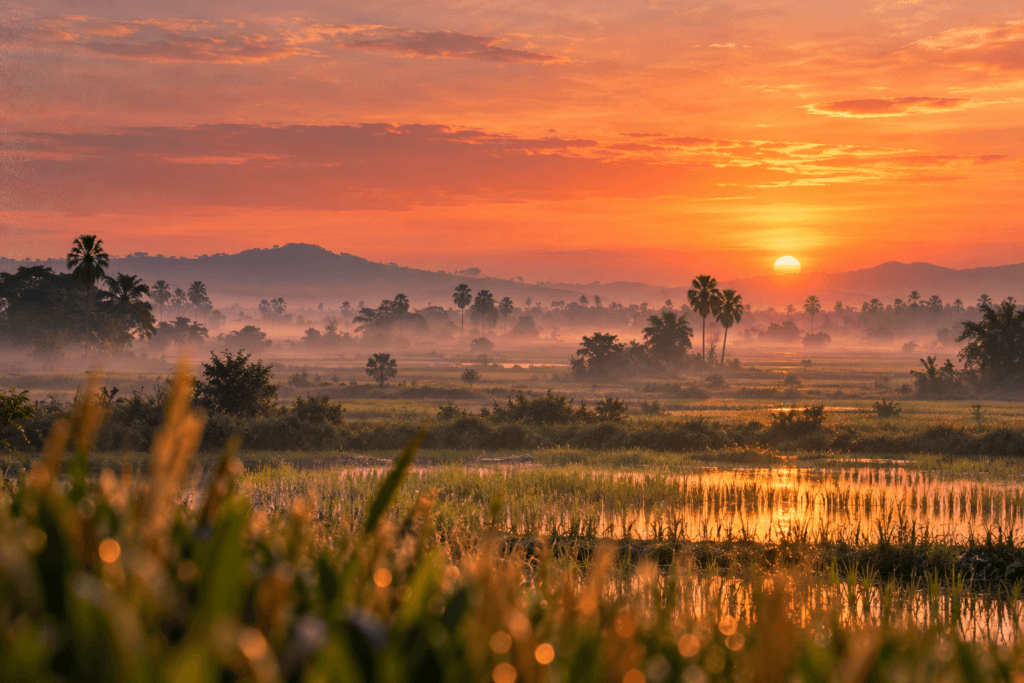
What Isan has instead is the beauty of agricultural Thailand at its most intact. Rice fields that turn the colour of jade in the rainy season and gold in October just before harvest. Villages where the temple is still the center of community life in a way that has diminished in the tourist areas of the country. The unhurried rhythms of provincial Thailand — the markets, the ceremonies, the monks collecting alms before sunrise — that exist here because they have always existed here, not because they have been preserved for anyone’s benefit.
And then there is Phu Kradueng.
In Loei province, on the western edge of Isan, a sandstone mountain rises to a plateau at 1,316 meters above sea level. The 8.5km climb is demanding. What you find at the top — open grassland, pine forests, cliff edges looking out over the Isan plain, sambar deer grazing between the tents of Thai campers, temperatures that drop below 10°C in January — is entirely unlike anything else in Thailand. The cloud inversion at dawn from Pha Nok Aen, the cliff that looks west over the valley, is one of the most extraordinary natural sights in the country. Almost no international visitors see it.
Full guide: Phu Kradueng National Park — hiking and camping guide →
Crossing into Laos
One of Isan’s less-discussed advantages is proximity to Laos. The Friendship Bridge at Nong Khai crosses the Mekong in ten minutes. On the other side is the Lao border post, and 25 kilometers beyond that is Vientiane — the most quietly compelling capital city in Southeast Asia.
Vientiane moves at a pace that feels borrowed from a different era. The French colonial boulevards are wide and tree-lined. Pha That Luang — the great gold stupa on the national flag — rises above its parkland with genuine grandeur. The Mekong promenade at sunset, with Thailand visible on the far bank, is one of those views that lodges in the memory and stays there.
For most visitors to Isan Thailand, Laos is a separate trip requiring separate planning. From Nong Khai it is a day out. Visa on arrival at the bridge costs $30 USD. The crossing itself takes 30 minutes. This geographical accident alone makes Isan worth understanding as a base rather than just a destination.
Full guide: Nong Khai and the Vientiane day trip — crossing into Laos →
The People
There is something different about the quality of welcome in Isan that is hard to articulate without sounding like a travel cliché. Thai hospitality is famous and genuinely practiced throughout the country. But in the tourist areas it has been shaped by decades of international visitors, by the expectations of people who have read the same guidebooks and follow the same Instagram accounts. There is sometimes a transactional quality to it that is nobody’s fault — it is simply what happens when any place becomes a destination.
In Isan, if a foreign visitor is a rare enough occurrence that your presence in a market stall causes the vendor’s children to come and look, the interaction that follows is a genuine one. The curiosity is real. The welcome is real. The laughter when your Thai is terrible is real. The insistence that you try something from the grill even when you didn’t ask for it is real.
Isan people have a reputation among Bangkok Thais for being direct, funny, unpretentious and occasionally irreverent. They are also, in my experience, the most generous hosts in the country. Coming as a visitor rather than an expat, this would be your experience too.
But there is something about Isan that can occasionally test a Western sense of order: Thai time.
Time operates differently here. Book someone to repair something in your home and they’ll give you a time — but it could be an hour later, or a day later, when they finally turn up. Yet order a new appliance from a shop and it will be delivered, fully installed and working, within the hour.
This is Isan. Sabai sabai. Mâi bpen-rai — never mind, no problem, it’ll work out. Once you stop fighting it, it’s one of the most genuinely relaxing ways to live. The urgency that drives daily life in the West simply doesn’t have the same hold here, and after a while you start to wonder why it ever did.
Who Should Come to Isan
Isan is not for every Thailand visitor. If your priority is a beach holiday, you should go to the beach — Koh Samui, Koh Lanta and Koh Yao Noi are all extraordinary and none of them are in northeast Thailand. If it’s your first trip to Thailand and you have two weeks, Bangkok and one island covers more of what Thailand is famous for internationally.
But if you have been to Thailand before and felt that something was missing — if you want to eat at the source of the food you’ve been ordering in Thai restaurants for twenty years, or you are considering a longer stay
In case you are considering a longer stay in the country and want to understand what daily life here actually looks like. If you are a photographer or a writer looking for material that hasn’t been photographed and written about a thousand times. If you want to stand on the bank of the Mekong River at dusk and look at Laos across the water with almost nobody else around. Isan is where you come.
It is the largest part of Thailand. The least visited. The most genuinely itself.
And it is, without question, the most interesting place I have ever lived.
Plan Your Isan Thailand Trip
Complete Travel Guide
Where to go, how to get there, what to expect and when to visit — the full practical reference.
Itineraries
7, 10 and 14-day routes covering the full northeast — Udon Thani, Nong Khai, Phu Kradueng, Khon Kaen and the Mekong circuit.
Udon Thani
Isan’s largest city and the main gateway — flights from Bangkok, what to see, Ban Chiang and the Red Lotus Sea.
Nong Khai & Laos
The Mekong riverside town and the Vientiane day trip — crossing the Friendship Bridge step by step.
Isan Food
Every som tam variation, larb type, gai yang and where to eat them in Khon Kaen — the food capital of northeast Thailand.
Phu Kradueng
The plateau hike that most tourists never find — trail guide, camping, what to pack and the sunrise at Pha Nok Aen.
Getting to Isan
Fly Bangkok to Udon Thani in one hour from £16 (Thai AirAsia / Thai Lion Air from Don Mueang). Coming from the UK or US, connect through Bangkok.
🎪 Things to Do — Tours & Activities
Book tours, transfers, day trips and activities with free cancellation on most experiences.
ⓘ We may earn a small commission at no extra cost to you.