
Ultimate Isan food Guide: Where to Eat Som Tam & Larb in Khon Kaen
Ultimate Isan food Guide: Khon Kaen is the university city of northeast Thailand — home to Khon Kaen University’s 40,000 students, a busy commercial center and one of the best food scenes in Isan. The combination of a large student population (who eat out constantly and on tight budgets) and a deeply Isan cultural identity produces a city where the food is excellent, the prices are low and the cooking hasn’t been modified for anyone’s comfort.
This is the place to eat proper Isan food. Not the Bangkok version. Not the tourist version. The kind made by people who grew up eating it, for people who eat it every day.
Part of our Northeast Thailand (Isan) Complete Travel Guide
Staying in Khon Kaen?
Staying around central Khon Kaen makes it easier to explore the city’s markets, restaurants and evening food scene.
Find hotels in Khon Kaen →
Understanding Isan Food Before You Order
The principles
Isan cuisine is built on four flavor principles: sour, spicy, salty and herbal. Sweetness is minimal compared to central Thai food. The heat is genuine — Isan cooks don’t routinely moderate chilli levels for non-Isan diners. If you have a low spice tolerance, learn the phrase phet nit noi (a little spicy) or mai phet (not spicy) and use it before every order.
The staple is khao niao (sticky rice), served in a small, covered basket and eaten with the hands. You pinch off a small ball, flatten it slightly and use it to scoop other dishes. Virtually everything in Isan cuisine is designed to be eaten this way. Don’t ask for steamed rice unless you specifically want it — sticky rice is the appropriate accompaniment and ordering it signals you know what you’re doing.
Isan eating is communal. Order multiple dishes for the table, eat everything together, share. Ordering one dish per person and eating separately is how tourists eat, not how Isan people eat.
The Ultimate Isan food Guide: Essential Vocabulary
| Thai/Isan word | Meaning | When to use it |
|---|---|---|
| Phet | Spicy | Basis for spice requests |
| Phet nit noi | A little spicy | Moderate heat tolerance |
| Mai phet | Not spicy | Low tolerance or for children |
| Suk | Cooked/well-done | Order larb suk to avoid raw meat |
| Khao niao | Sticky rice | Always order this |
| Aroy | Delicious | Most useful word you’ll use |
Som Tam — The Dish That Defines Isan
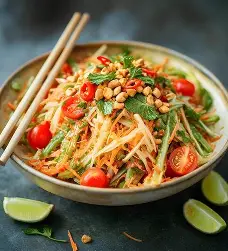
Som tam (papaya salad) is the most exported dish in the Isan canon — served in Thai restaurants worldwide, usually in a modified form. In Khon Kaen, eating som tam means encountering the original. The differences are significant.
How Isan Som Tam Differs from Bangkok Som Tam
Bangkok versions tend toward sweeter, more rounded flavors with palm sugar moderating the sourness and heat. Isan som tam is sharper, sourer (more lime, sometimes fermented fish sauce called pla ra instead of regular fish sauce), spicier and more pungent. It’s also made faster and with more physical force — the pestle work in the mortar is vigorous, bruising the papaya rather than just mixing it.
Som Tam Variations Worth Ordering
| Name | What makes it different | Heat level |
|---|---|---|
| Som tam Thai | the ‘standard’ version — papaya, tomato, long beans, peanuts, dried shrimp. Regular fish sauce. | 🔴 Moderate |
| Som tam poo | with raw fermented crab (poo). Stronger, more pungent, authentically Isan. The fermented crab adds umami depth. | 🔴🔴 High |
| Som tam poo pla ra | Fermented crab AND fermented fish sauce. The most intense version. Not for the uninitiated. | 🔴🔴🔴 Very high |
| Som tam Lao | Isan-style (as opposed to Thai-style) — uses fermented fish sauce as standard, no peanuts, longer and fiercer. | 🔴🔴 High |
| Tam taeng | Made with cucumber instead of papaya. Milder, crunchy, refreshing — good gateway dish. | 🔴 Moderate |
| Tam khanom jeen | Som tam served over rice vermicelli noodles. A full meal in one dish. | 🔴 Moderate |
Price: 30–50 THB per plate at market stalls. 50–70 THB at sit-down restaurants.
How to Spot a Good Som Tam Stall
Look for: a visible stone mortar (not plastic or metal), a queue of Thai customers, a vendor who asks how spicy you want it, fresh ingredients visibly prepped at the stall. If the stall is outside and cash-only with plastic stools, those are all good signs. If it has an English menu and a photo of each dish, the som tam is probably not the primary reason to be there.
Larb — The Ceremony Dish
Larb (also spelled laab or laap) is technically a salad but functions more like a celebration dish. It’s made from minced or finely chopped meat — pork, chicken, duck or fish — mixed with toasted rice powder, dried chilies, fresh herbs (mint, spring onion, lemongrass), lime juice and fish sauce. The toasted rice powder is what distinguishes it from other minced meat preparations: it adds a smoky, nutty depth and a slightly gritty texture that is entirely distinctive.
Larb Variations
| Type | Meat | Notes |
|---|---|---|
| Larb moo | Pork | Most common, usually safe to order Suk (cooked) |
| Larb gai | Chicken | Good entry point, milder in flavor |
| Larb ped | Duck | Richer, more intense. Excellent when done well. |
| Larb neua | Beef | Sometimes served raw or barely cooked in traditional Isan style |
| Larb pla | Fish | Less common but very good; the fish is cooked |
| Larb dip | Any meat, raw | Traditional Isan preparation. Common at village ceremonies. High-risk for visitors; approach with caution. |
Important: In traditional Isan cooking, larb is sometimes prepared with partially or fully raw meat (larb dip). At market stalls, always specify suk (cooked) unless you know what you’re ordering. At reputable restaurants this is less of an issue. The toasted rice powder is always added after cooking and is always present — its absence suggests an inauthentic preparation.
Price: 50–80 THB at market stalls. 70–120 THB at restaurants.
The Full Isan Menu: Other Dishes to Order
Gai Yang — Grilled Chicken
Whole or half chickens marinated in lemongrass, galangal, garlic and coriander root, then grilled slowly over charcoal. The best gai yang in Thailand is found at roadside stalls and markets in Isan, not in Bangkok restaurants. Look for vendors with a charcoal grill, multiple whole birds on the rack and a bottle of sauce for dipping (usually jaew — a tamarind-chilli-toasted rice dipping sauce). Order by the piece or by weight. Always eaten with sticky rice and som tam.
Price: 30–60 THB per piece, 80–150 THB for a half bird.
Tom Saep — Isan Spicy Soup
A pork rib soup seasoned heavily with lemongrass, galangal, kaffir lime leaves, dried chili and fish sauce. Much more aggressively spiced than tom yum. The broth is clear but incendiary. Eaten communally from a large bowl in the center of the table while picking at ribs with fingers. Outstanding when cold outside, brutal in 38-degree heat. Available at most Isan restaurants.
Price: 60–80 THB per bowl (usually large enough to share).
Sai Krok Isan — Fermented Sausages
Small sausages made from minced pork, cooked rice and garlic, then fermented for 2–3 days to develop a characteristic sour flavor. Grilled to order and eaten with fresh ginger, fresh chili and spring onion. The sourness is distinctive and acquired — try one before committing. Found at morning markets, roadside stalls and some night markets.
Price: 10–20 THB per sausage.
Nam Tok — Waterfall Salad
Grilled pork or beef sliced and dressed in the same way as larb — toasted rice powder, herbs, lime, fish sauce, dried chili — but using sliced meat rather than minced. Slightly milder than larb. The name refers to the juices running off the meat during grilling. An excellent gateway to Isan flavors for those nervous about larb.
Price: 60–80 THB.
Where to Eat in Khon Kaen
Tonson Night Market
One of Khon Kaen’s most popular evening food destinations, running most nights from around 5pm. Strong representation of all the Isan staples — som tam stalls, gai yang vendors, larb, sticky rice everywhere. The market is oriented toward local students and families, which keeps prices honest and quality high. Budget 60–120 THB for a full meal including sticky rice and a drink.
Ton Tann Market (Talat Ton Tann)
A large weekend market complex that’s as much about food as it is about shopping. Multiple permanent food stalls and pop-up vendors. The som tam section alone has half a dozen stalls to compare. Best visited Saturday or Sunday from 4pm onwards when it’s at full capacity. Air-conditioned food courts also available inside for when the heat becomes an issue.
Khon Kaen Morning Market Area (Talat Tong Sim)
The central morning market is active from around 5am until 9am. The freshest ingredients in the city pass through here, and several prepared-food vendors operate from the surrounding streets. The best breakfast in Khon Kaen — noodle soup (kuay teow), grilled pork with sticky rice, fresh-squeezed juice — costs 50–70 THB total and is ready by 6:30am.
The University Area (Mittraphap Road)
The streets around Khon Kaen University are lined with student-facing restaurants and street stalls offering some of the cheapest food in the city. Meals from 40–60 THB. The cooking is aimed at Thai students who want Isan food fast and affordable — which means it’s exactly what you want. Som tam and gai yang stalls cluster around the university gates particularly in the lunch hour (11:30am–1pm) and dinner hour (5:30–7pm).
Raan Som Tam Stalls on Pimpha Road
Pimpha Road and the streets branching off it have a concentration of dedicated som tam shops (raan tam). These are specialists rather than general restaurants — they make som tam and the dishes that go with it (gai yang, sticky rice, larb, tom saep) and nothing else. The narrowness of focus means high quality and fast service. Aim for stalls where the vendor is actively using the mortar rather than standing waiting — busy means fresh.
Getting Around Khon Kaen
If you’re planning to explore beyond the city center, compare local transport and onward travel options before setting out.
Check buses and trains →
Isan Food Etiquette
- Eat with your right hand. Break off sticky rice, flatten it, scoop with it. Don’t use chopsticks for sticky rice — that’s for Chinese-style rice dishes.
- Order more than you think you need. Dishes are small by design — the eating is in the variety. Three or four dishes between two people is normal.
- Drink cold water or cold tea. Beer is fine but locals often drink water or sweet iced tea to offset the heat of the food. Beerlao (imported from Laos, widely available in Isan) is an excellent pairing.
- Don’t ask for modifications at market stalls. You can ask for spice level adjustment, but asking for a dish without fish sauce or without certain ingredients at a busy market stall will generally not go well. Accept the dish as designed or choose something else.
- Say aroy. Telling a vendor their food is delicious (‘aroy’ or ‘aroy Mak’ — very delicious) costs nothing and is always appreciated.
Isan Food Around the Rest of Northeast Thailand
Everything in this Ultimate Isan food guide applies across Isan, not just Khon Kaen. The dishes are the same throughout the region; what changes is the specific vendors and the slight local variations in seasoning. Udon Thani has a strong food scene built around its night markets and morning market. The full Isan travel guide covers the region’s other cities and destinations.
Exploring Isan by road?
Having your own transport makes it much easier to combine Khon Kaen with smaller towns, markets, temples and countryside across Northeast Thailand.
Compare car hire in Khon Kaen →
Related Guides
- Northeast Thailand (Isan) Travel Guide 2026 — The Complete Introduction
- Udon Thani Travel Guide 2026 — What to See, Where to Stay & Day Trips
- Nong Khai & Vientiane Day Trip Guide 2026 — Crossing into Laos
- Phu Kradueng National Park: Hiking & Camping Guide 2026