
Nong Khai & the Vientiane Day Trip: Crossing into Laos from Northeast Thailand
Nong Khai is a Mekong River town 55km north of Udon Thani and the most straightforward Thailand–Laos border crossing for independent travelers. It’s a relaxed, walkable riverside town in its own right — worth a half-day even without crossing into Laos — but most visitors come for what’s on the other side of the Friendship Bridge: Vientiane, the Lao capital, 25km from the Thai bank of the Mekong.
The combination — a morning in Nong Khai, an afternoon and evening in Vientiane, back the same night or staying overnight — is one of the most rewarding and underrated travel days in Southeast Asia.
Part of our Northeast Thailand (Isan) Complete Travel Guide →
Nong Khai: What’s Here
The Riverside & Mekong Views
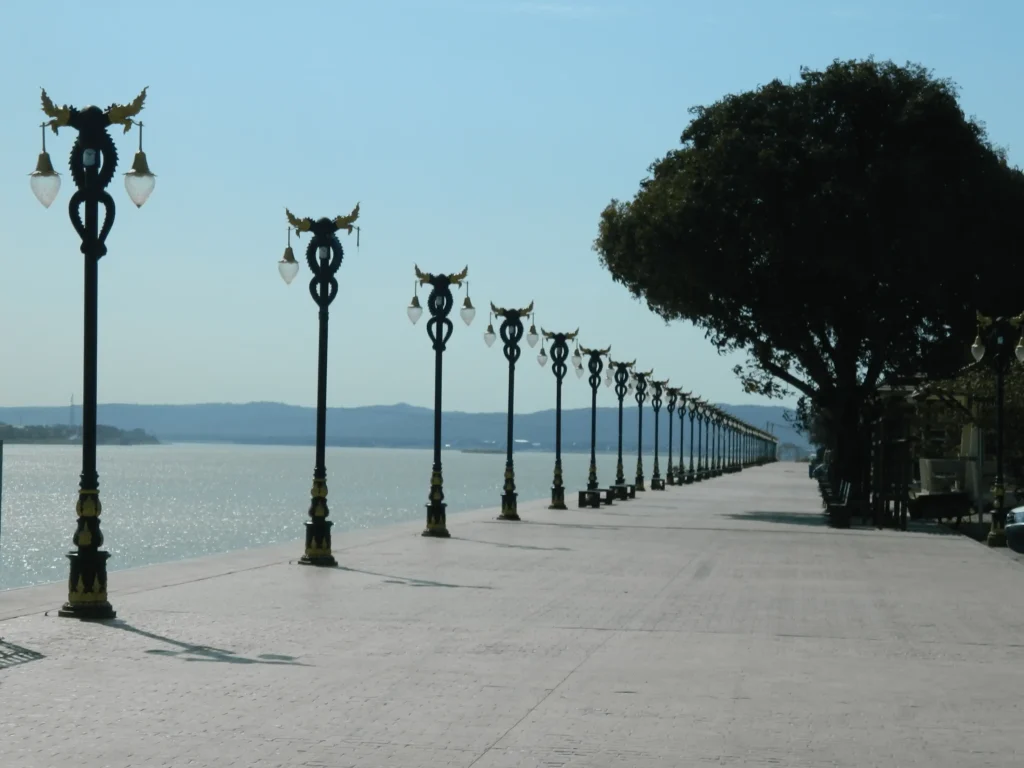
Nong Khai’s main street runs parallel to the Mekong and the views across the river to Laos are one of the town’s defining features. In the dry season (November–April) the water level drops and sandbanks appear mid-river; in the wet season the Mekong runs full and brown and powerful. The riverside at dusk, with the Laos bank lit up across the water, is particularly atmospheric.
The main riverside road — Kaeo Worawut Road — has a string of restaurants and bars with terrace seating facing the river. Good for a beer and a meal at any time of day.
Sala Kaeo Ku (Wat Khaek)
One of Thailand’s most genuinely strange and compelling attractions, and almost entirely unknown outside Isan. Sala Kaeo Ku is a sculpture park about 4km east of town containing enormous concrete statues of Buddhist, Hindu and syncretic mythological figures — some up to 25 meters tall. The park was created by Luang Pu Bunleua Sulilat, a shamanistic spiritual teacher who developed his own religious philosophy blending Hinduism, Buddhism and animism.
The results are extraordinary and unsettling: a massive multi-armed deity looms over a circle of disciples; a giant Buddha sits inside a structure representing the cycle of life entered through an enormous stone mouth; mythological creatures wrap around temple structures. The aesthetic is somewhere between religious monument and outsider art installation. Nothing else looks like it.
Entry: 40 THB. Open daily 8am–5pm. Hire a tuk-tuk from town (60–80 THB return with waiting time).
The Nong Khai Morning Market
Active from around 5:30–9am along the streets near the main market building. Strong cross-border character — Lao traders bring goods across the river and you’ll find Lao textiles, pottery and dried goods alongside the usual Thai fresh produce and prepared food. Good for breakfast: noodle soup, grilled items and fresh fruit at prices even lower than Udon Thani.
The “Naga Fireball” Phenomenon (October)
On the night of Ork Phansa (the end of Buddhist Lent, a moveable feast in October), glowing orbs of light rise from the Mekong River along the Nong Khai stretch and float silently upward before disappearing. Thousands of Thais line the riverbank to witness it. The phenomenon has been documented and filmed many times; its cause is genuinely disputed (methane release, mass hallucination, and miraculous origin all have their proponents). Watching it from the Nong Khai riverbank in October, in a crowd of believing Thai Buddhists, is one of the more otherworldly experiences available in this part of the world.
Crossing to Laos: The Friendship Bridge
The Crossing Process — Step by Step
- Get to the Thai border terminal at the Nong Khai end of the Friendship Bridge. Tuk-tuks from town run for around 60 THB. The terminal is clearly signposted.
- Complete Thai departure formalities at the immigration counter. Straightforward — stamp out of Thailand.
- Take the shuttle bus across the bridge. A shared bus crosses every 20 minutes, 20 THB per person. The crossing takes about 10 minutes. You cannot walk or cycle across.
- Laos arrival at Nong Khai / Tha Naleng border post. Most nationalities (including UK and US) can obtain a Laos visa on arrival here. Cost: $30 USD (or equivalent in THB at a poor rate — bring USD). Processing time: typically, 15–30 minutes. You’ll need a passport photo and a completed arrival form.
- From the Lao border to Vientiane: shared taxi or tuk-tuk, around 25km, 10,000–20,000 Lao Kip (roughly £4–8 / $5–10 per vehicle). Negotiate before getting in. Journey: 25–35 minutes.
Planning your journey to Nong Khai or Vientiane?
Check current bus, train and cross-border transport options before travelling.
Compare transport to Nong Khai & Vientiane →
Visa on arrival hours: The Laos visa-on-arrival desk at Nong Khai operates approximately 6am–8pm. Don’t arrive after 5pm if doing a same-day return. Weekend processing can be slightly slower. Check current entry requirements before travel as visa conditions do occasionally change.
What You’ll Need
- Valid passport (minimum 6 months validity)
- $30 USD in cash for the Laos VOA (or 1,500 THB, though the dollar rate is better)
- One passport-sized photo (some booths sell them at the border if you forget)
- Completed arrival card (available at the border)
Vientiane: What to Do
Vientiane is the Lao capital and one of Southeast Asia’s most relaxed, low-key cities. It’s small enough to walk or cycle much of, genuinely different from Thailand in atmosphere and appearance, and has a distinctive Franco-Lao colonial character in its older streets and buildings. A full day is enough to cover the main attractions.
Pha That Luang
The great stupa of Pha That Luang is Laos’s most important national monument — a 45-metre gold-covered Buddhist stupa that appears on the national flag and coat of arms. Construction of the current structure dates to the 16th century on the site of an earlier Khmer temple. The surrounding parkland is peaceful, and the structure itself is genuinely impressive in person. About 4km from the city center. Entry: 10,000 Kip (~£0.35).
Patuxai (Victory Gate)
A triumphal arch in the style of the Paris Arc de Triomphe, built in the 1960s using US-donated concrete originally intended for an airport runway. The Lao government is well aware of the irony. Climb to the top for views over the city. The surrounding avenue is tree-lined and pleasant for walking in the cooler parts of the day.
Buddha Park (Xieng Khuan)
A 15km drive from central Vientiane along the Mekong riverside road, Buddha Park is the original sculpture park created by the same spiritual teacher (Luang Pu Bunleua Sulilat) who later built Sala Kaeo Ku in Nong Khai after being expelled from Laos. The Vientiane version came first and is slightly smaller but also extraordinary. Worth combining with Pha That Luang in a single tuk-tuk tour.
Want to explore Vientiane with a guide?
Compare available Vientiane tours and experiences.
See Vientiane activities →
COPE Visitor Centre
A sobering and important exhibition about UXO (unexploded ordnance) clearance in Laos — the most heavily bombed country per capita in history, primarily from US bombing during the Vietnam War. The center documents the ongoing impact of cluster munitions and the work of the COPE charity providing prosthetics to victims. Free entry. A genuinely worthwhile hour that contextualises much of what you see in the country.
Eating in Vientiane
The Lao food scene in Vientiane centers on the night market area near the Mekong and the Rue Setthathirath restaurant strip. Key things to eat:
- Khao niao (sticky rice) — the same staple as Isan, eaten with everything
- Laap — the Lao version of larb, slightly different seasoning
- Tam mak hoong — Lao som tam, often more sour and less sweet than Thai versions
- Baguette sandwiches — a genuine legacy of French colonialism. The baguette culture in Vientiane is real and the breakfast sandwiches (often with pâté, vegetables and chilli) are outstanding.
- Beerlao — the national beer and one of Southeast Asia’s better lagers. Noticeably cheaper than Chang or Singha across the bridge.
Day Trip vs Overnight: Which Is Better?
| Factor | Day Trip | Overnight |
|---|---|---|
| Time | Enough for main sights | See more, more relaxed pace |
| Cost | Save on accommodation | Vientiane hotels from £15–30 |
| Border | Cross twice same day | Morning return, less rushed |
| Evening | Miss Vientiane at night | Night market, riverside bars |
| Verdict | Fine for a first visit | Better if time allows |
Staying Overnight in Vientiane?
Staying overnight removes the pressure of crossing the border twice in one day and gives you more time to experience Vientiane after dark.
Getting from Udon Thani to Nong Khai
- Bus from Udon Thani Bus Terminal: Regular departures to Nong Khai, 40–60 THB, 45–60 minutes. Most frequent in the morning.
- Shared minivan: Slightly faster, 50–60 THB per person. Depart when full of near the bus terminal.
- Grab or taxi: Around 300–400 THB for the 55km. More convenient if you have luggage or early morning plans.
- Train: A special international train service runs from Nong Khai station across the bridge to Thanaleng (Vientiane) on a limited schedule — an atmospheric option but check current timetables as services are infrequent.
Travelling from Udon Thani?
Compare available bus and train connections before your journey.
Check Udon Thani → Nong Khai transport →
→ Read our Complete Udon Thani Travel Guide
Prefer to have mobile data ready before crossing the border?
Check available Laos eSIM options before travelling.
Practical Notes
- Currency in Laos: Lao Kip is the official currency. USD, Thai Baht and occasionally EUR are widely accepted in Vientiane tourist areas. The exchange rate you’ll get using Baht is fair; using USD is often marginally better. BCEL bank in Nong Khai has a reliable exchange before you cross.
- SIM card: Your Thai SIM won’t work in Laos without roaming activated (often expensive). A Lao SIM is cheap at the border (around 50,000 Kip / £2) if you need data for maps and translation.
- Tuk-tuks in Vientiane: Always agree the price before getting in. A tuk-tuk from the Lao border crossing to central Vientiane should be around 50,000–80,000 Kip per vehicle.
- Dress for temples: Shoulders and knees covered at Pha That Luang and other wat. Sarongs available at the entrance if needed.
Staying in Nong Khai?
Nong Khai is worth more than simply passing through on the way to Laos. Staying beside the Mekong also makes an early border crossing much easier.
Related Guides
- Northeast Thailand (Isan) Travel Guide 2026 — The Complete Introduction
- Udon Thani Travel Guide 2026 — What to See, Where to Stay & Day Trips
- Ultimate Isan food Guide: Where to Eat Som Tam & Larb in Khon Kaen
- Phu Kradueng National Park: Hiking & Camping Guide 2026