
Northeast Thailand (Isan) Travel Guide 2026 — The Complete Introduction
Northeast Thailand (Isan): Thailand’s northeast rarely receives the same attention as Bangkok, Phuket, Chiang Mai or the southern islands. And that’s precisely part of its appeal.
Known as Isan — also commonly written Isaan — Northeast Thailand covers 20 provinces stretching from the gateway city of Nakhon Ratchasima to the Mekong River and the borders with Laos and Cambodia. It’s a vast region of rice fields, ancient Khmer ruins, prehistoric archaeological sites, national parks, temples, lively cities and some of Thailand’s most distinctive food and traditions.
Watch the sun rise over the Mekong, explore ancient stone temples, visit a village market, discover prehistoric Thailand or spend an evening eating grilled chicken, som tam and sticky rice alongside local families.
This guide is your introduction to travelling Northeast Thailand in 2026: where Isan is, the best places to start, how to get there, when to visit, what to eat and how to plan your first journey through the region.
Planning your first Isan trip?
Start here, then use our detailed destination and itinerary guides to build your journey through Northeast Thailand.
- Udon Thani Travel Guide 2026 — What to See, Where to Stay & Day Trips
- Nong Khai & Vientiane Day Trip Guide 2026 — Crossing into Laos
- Ultimate Isan food Guide: Where to Eat Som Tam & Larb in Khon Kaen
- Phu Kradueng National Park: Hiking & Camping Guide 2026
What Is Isan?
Isan (also spelled Isaan, Issan or E-San) is the collective name for Thailand’s 20 northeastern provinces, stretching from Loei in the northwest down to Ubon Ratchathani in the southeast, bounded by the Mekong River and Laos to the north and east, and Cambodia to the southeast. It’s the largest of Thailand’s four main regions by area and population.
The Isan people have their own distinct identity — their own dialect (closer to Lao than central Thai), their own food culture, their own festivals and their own way of doing things. Much of the population has ancestral roots in what is now Laos. Bangkok Thais and Isan Thais are distinct in ways that go beyond geography, and visiting Isan means engaging with something genuinely different to the rest of the country.
The region is the economic heartland of Thai agriculture and the source of much of Bangkok’s service industry workforce — but it remains significantly poorer than central Thailand on average. That economic reality shapes the experience: prices are lower, life moves at a different pace, and the tourism industry is oriented toward Thai domestic visitors rather than international ones.
Why Visit Northeast Thailand?
- It’s genuinely off the tourist trail. In most of Isan you’ll encounter very few other foreign visitors, particularly outside Udon Thani and the Mekong towns. Markets, temples and daily life are entirely unmodified for tourism.
- The food is outstanding. Isan cuisine — Som tam, larb, gai yang (grilled chicken), khao niao (sticky rice), tom saep — is widely considered the most flavorful and addictive regional food in Thailand. Eating it in Isan, where it’s made by people who grew up eating it, is a different experience from the tourist-area versions.
- Prices are the lowest in Thailand. Accommodation, food, transport and activities all cost significantly less than Bangkok, Chiang Mai or the islands. A good guesthouse room is 300–600 THB. A full meal from a local restaurant is 50–80 THB.
- The Mekong River. The northern boundary of Isan follows the Mekong — one of the world’s great rivers. Towns like Nong Khai, Mukdahan and Nakhon Phanom sit right on the bank and offer views across to Laos that are worth making the trip for alone.
- Access to Laos. The Friendship Bridge at Nong Khai is one of Southeast Asia’s most straightforward border crossings. Vientiane — one of the region’s most relaxed and underrated capital cities — is 25km from the Thai side and an easy day trip or overnight from Nong Khai or Udon Thani.
- Archaeological significance. Ban Chiang, east of Udon Thani, is one of Southeast Asia’s most important prehistoric sites — a UNESCO World Heritage site with bronze age artefacts dating back 5,000 years that predate previously-assumed timelines for Southeast Asian civilisation.
That makes the Northeast particularly interesting for travelers who enjoy local markets, regional food, road trips, temples, history and simply seeing how another part of Thailand lives.
It isn’t a replacement for Bangkok or Phuket.
It’s another Thailand altogether.
Best Places to Visit in Isan for First-Time Travelers
Udon Thani
Udon Thani makes an excellent base for exploring the upper Northeast.
The province combines a modern regional city with important historical and natural attractions. TAT highlights Ban Chiang, Wat Pa Phu Kon and the Red Lotus Lake at Nong Han Kumphawapi among its notable sights.
The wider Udon region also provides access towards Nong Khai and the Mekong.
For history lovers, this area becomes particularly interesting because of the archaeological heritage surrounding Ban Chiang and the wider prehistoric landscape of Northeast Thailand.
Ultimate Isan food Guide: Where to Eat Som Tam & Larb in Khon Kaen
Nong Khai
Continue north and you reach the Mekong and Nong Khai.
This relaxed riverside province faces Laos across the river and offers temples, markets, Mekong scenery and easy access to the Thai Lao Friendship Bridge. The annual Naga Fireball phenomenon around the end of Buddhist Lent is one of the area’s best-known events.
Udon Thani and Nong Khai also work naturally as a combined trip rather than two completely separate holidays; TAT itself promotes itineraries linking the two provinces.
Nong Khai & Vientiane Day Trip Guide 2026 — Crossing into Laos
Khon Kaen
Khon Kaen gives visitors a different view of Isan again.
It’s one of the region’s major urban and commercial centers, home to Khon Kaen University and surrounded by areas known for traditional silk production.
That makes it useful for travelers who want the convenience of a sizeable Thai city while exploring the center of the Northeast.
It can also work well as a transport base for journeys deeper into Isan.
Search Bangkok to Khon Kaen flights →
Roi Et
My Hometown, Roi Et offers a quieter introduction to everyday life in central Isan and is a good choice for travelers who want to move beyond the region’s larger cities.
The provincial capital is centered around Bueng Phlan Chai, a large lake and park in the heart of the city. One of Roi Et’s most striking landmarks is Wat Burapha Phiram, home to the towering standing Buddha known as Phra Phuttha Rattana Mongkhon Maha Muni.
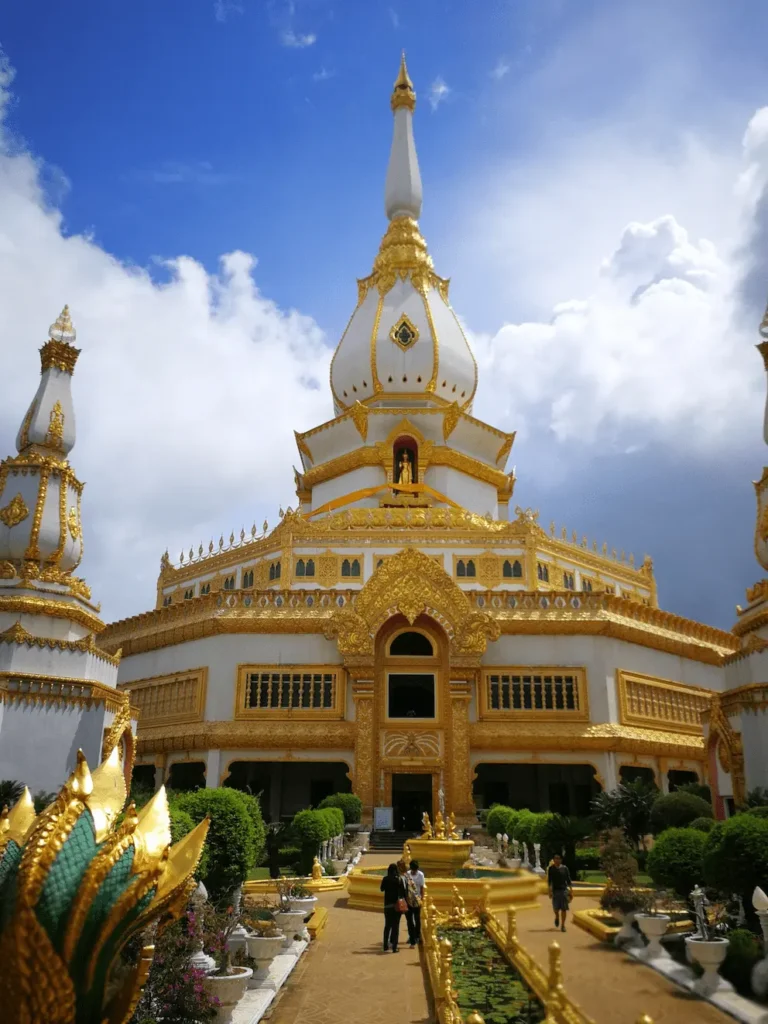
Outside the city, the province opens into the rice-growing landscapes, small towns and villages that characterise much of central Northeast Thailand. Further North from Roi Et is Phra Maha Chedi situated on a hill overlooking the landscape below.
Roi Et is particularly suited to travelers who enjoy slow travel, local food, temples and experiencing a provincial Thai city without a major international tourism scene.
Search Bangkok to Roi Et flights →
Nakhon Ratchasima (Korat)
Often called Korat, Nakhon Ratchasima is an important gateway between Bangkok and Northeast Thailand.
The province contains important historical sites associated with the Khmer and Dvaravati periods, including the famous Khmer temple complex at Phimai. TAT also describes Korat as an important transportation and economic hub for Northeast Thailand.
For someone travelling overland from Bangkok, Korat can make an excellent introduction to Isan before continuing farther northeast.
Ubon Ratchathani
At the eastern end of Isan, Ubon Ratchathani combines nature, archaeology and Buddhist culture.
Highlights include Pha Taem National Park, known for its prehistoric rock paintings, and the dramatic Mekong landscapes around Sam Phan Bok. Ubon’s annual Candle Festival is one of the province’s major cultural events.
This is an excellent destination for travelers who want to combine a regional city with national parks and more remote landscapes.
Phu Kradueng National Park: Hiking & Camping Guide 2026
Isan Food: One of the Biggest Reasons to Visit
You may already have eaten Isan food without realising how closely it is associated with Northeast Thailand.
Som tam
spicy green papaya salad — is probably the best-known example.
Add sticky rice, grilled chicken, larb, grilled meats, sausages and countless regional variations and food quickly become a major part of travelling here.
And eating in Isan doesn’t need to mean hunting down fashionable restaurants.
Some of the most enjoyable experiences come from morning markets, evening markets, roadside restaurants and simple family-run places.
Food also changes as you travel across the Northeast, particularly around areas influenced by communities along the Mekong and neighboring Laos.
Ultimate Isan food Guide: Where to Eat Som Tam & Larb in Khon Kaen
| Dish | What it is | Typical price |
|---|---|---|
| Som tam | Papaya salad — shredded green papaya pounded with chili, lime, fish sauce, dried shrimp, tomato. Isan-style is fierier and more fermented than Bangkok versions. | 30–50 THB |
| Gai yang | Grilled marinated chicken, cooked over charcoal. The roadside versions in Isan are extraordinary — better than anything served in Bangkok. | 40–80 THB (half bird) |
| Larb | Minced meat salad with toasted rice powder, herbs, lime and chili. Pork, chicken or duck. The Isan version often includes raw or partially-cooked meat — order Suk (cooked) if preferred. | 50–80 THB |
| Tom saep | Isan-style spicy soup with pork ribs, lemongrass, galangal and dried chili. Much more punishing than tom yum. Outstanding when cold. | 60–80 THB |
| Sai Krok Isan | Fermented pork sausages with garlic and cooked rice. Sour, rich flavor. Eaten as a snack with fresh ginger, chili and spring onion. Available at morning markets and roadside stalls. | 10–20 THB per sausage |
| Nam tok | Grilled pork or beef salad — similar to larb but made with sliced meat rather than minced. The name means “waterfall” — referring to the juices running off the meat on the grill. | 60–80 THB |
Where to eat in Isan: Morning markets (Talat chao) are the best source of fresh prepared food from 6–9am. Night markets appear in most towns from around 5pm. Local raan khao (rice shops) serve the full Isan repertoire cheaply throughout the day. Avoid tourist-facing restaurants for Isan food specifically — the cooking is better and cheaper at local places.
How to Get to Isan
Despite its reputation as somewhere “off the beaten track,” Northeast Thailand isn’t particularly difficult to reach.
By Air
Several major Isan cities have airports with domestic connections, making flying useful if you’re short on time.
Depending on your itinerary, regional gateways can include Udon Thani, Khon Kaen, Ubon Ratchathani and Buriram.
Compare flights to Northeast Thailand →
By Train
Rail travel is one of the most interesting ways of reaching the Northeast from Bangkok.
Rail routes run through major northeastern destinations and onward towards Nong Khai, while another corridor serves the eastern side of the region towards Ubon Ratchathani. Current TAT railway material includes routes through destinations such as Nakhon Ratchasima, Buriram, Surin, Khon Kaen, Udon Thani and Nong Khai.
For travelers with time, the journey itself can become part of the trip.
Check trains and buses to Northeast Thailand →
By Bus
Long-distance buses and minivans connect Bangkok with cities throughout Isan and also connect regional cities with one another.
They can be particularly useful for routes where flying or rail isn’t convenient.
Check trains and buses to Northeast Thailand →
By Car
For travelers comfortable driving in Thailand, a car opens up considerably more of Isan.
Many of the region’s most interesting temples, archaeological sites, rural communities, national parks and viewpoints aren’t concentrated around city centers.
A car also makes multi-province routes much easier.
Compare car hire in Thailand →
By Motorbike
Motorbikes can be useful locally and experienced riders may enjoy touring parts of Northeast Thailand.
But distances can be substantial, road conditions vary and rural riding is very different from renting a scooter for a few kilometers around a resort.
Use proper protective equipment, check insurance and license requirements, and don’t assume a standard travel-insurance policy covers motorcycle use.
Compare motorcycle and scooter rentals →
Getting Around Isan
Isan requires more independent planning than Bangkok or the islands. Public transport between cities exists (buses and occasional minivans) but is slower and less frequent than elsewhere in Thailand. The most practical options:
- Renting a car — the single best way to explore Isan properly. Roads are good, traffic is light, petrol is cheap. International license required. Several car rental operators at Udon Thani Airport.
- Renting a motorbike — available in most towns for 200–350 THB/day. Good for single-destination exploration but impractical for cross-province travel.
- Intercity buses — air-conditioned buses connect the main Isan cities reasonably well. Check departure times in advance — services are less frequent than in central Thailand.
- Grab — available in Udon Thani and Khon Kaen, patchy elsewhere. Don’t rely on it in smaller towns.
- Songthaews — shared pickup trucks serve local routes within and between smaller towns. Cheap, frequent on main routes, confusing until you understand the system.
When Is the Best Time to Visit Isan?
There isn’t one perfect month because what you want to experience matters.
November to February
For many travelers, the cooler months are the easiest time to explore.
Temperatures are generally more comfortable for road trips, outdoor sightseeing, markets and temples.
This period also coincides with some seasonal attractions. Around Udon Thani, for example, the famous Red Lotus Lake is associated with the cooler-season flowering period. TAT identifies roughly December to February as the key period.
March to May
Expect considerably hotter conditions.
Outdoor sightseeing can become demanding during the middle of the day, so early starts and slower afternoons make sense.
May to October
The rainy season transforms much of Isan.
Rice fields and countryside become intensely green, waterfalls and rivers gain strength, and the landscape can look spectacular.
Rain doesn’t necessarily mean continuous rain all day, but travelers planning road trips should allow flexibility for changing conditions.
Thailand Weather & Flight Booking Calendar →
| Season | Months | Conditions | Best for |
|---|---|---|---|
| Cool Season | November–February | Dry, 20–30°C. Mornings can be cool, especially December–January. | Best overall. Comfortable outdoor exploring. |
| Hot Season | March–May | Very hot and dry. 35–40°C common. April is extreme. | Songkran (April) water festival. Otherwise, grueling. |
| Rainy Season | May – October | Daily afternoon rain. Green landscape. Occasional flooding in low-lying areas. Humidity high. | October: Naga Fireballs at Nong Khai. Candle Festival at Ubon (July). |
Isan’s cool season (November–February) is ideal — it doesn’t suffer the tourist crowds that cool season brings to Chiang Mai or Phuket, so you get the best weather with none of the peak-season pricing.
How Long Do You Need in Isan?
This is where I’d deliberately introduce article #3 of your cluster.
3–4 Days
Choose one base rather than attempting to cross the region.
Udon Thani + Nong Khai would be one possibility.
Korat and nearby historical attractions would be another.
7 Days
A week gives you enough time to combine several destinations without spending the entire trip moving.
10–14 Days
This is where Northeast Thailand becomes particularly interesting.
You can build a proper road or rail journey combining cities, countryside, historical sites and the Mekong.
Is Isan Suitable for First-Time Visitors to Thailand?
Absolutely — for the right traveler.
If your dream first trip to Thailand involves tropical islands, luxury beach resorts and nightlife every evening, I’d still include southern Thailand.
But if you’re interested in food, culture, temples, history, landscapes and everyday Thai life, there’s no rule saying you have to wait until your fifth Thailand holiday before visiting Isan.
A first trip could easily combine:
Bangkok → Isan → Bangkok
or:
Bangkok → Isan → Chiang Mai
or:
Bangkok → Isan → Southern Thailand
You don’t have to choose between famous Thailand and lesser-visited Thailand.
You can experience both.
Where Should You Stay in Isan?
For a first trip, I’d generally stay in established regional centers and use them as bases for day trips.
Places such as Udon Thani, Khon Kaen, Korat and Ubon Ratchathani provide a much wider selection of accommodation and transport than small rural destinations.
Then mix those city stays with smaller towns or countryside accommodation once the route requires it.
Find hotels across Northeast Thailand →
Is Northeast Thailand Expensive?
Isan can offer excellent value, particularly outside the major tourist centers, but I wouldn’t sell it as simply “cheap Thailand.”
That’s the wrong positioning.
Accommodation, local food and everyday transport can be inexpensive compared with major international resort destinations, but your actual budget depends heavily on how you travel.
A private car, domestic flights and higher-end hotels produce a very different budget from regional trains, local restaurants and guesthouses.
More importantly, come to Isan because you want to experience Isan — not simply because you want to spend less money.
→ Estimate your Thailand trip with our Thailand Trip Cost Calculator
Isan Travel Tips for 2026
English is widely encountered in Thailand’s tourism industry, but it can be less prevalent once you move into smaller towns and rural areas of the Northeast. Translation apps can be genuinely useful.
Carry some cash. Card and mobile payments are widespread in cities, but cash remains useful for small markets, rural shops and local restaurants.
Don’t try to see all 20 provinces in one trip. Pick a route.
Build flexibility into rural travel days.
Dress respectfully when visiting temples.
And most importantly, slow down.
Isan makes far more sense when you’re not treating every day as a race between attractions.
Practical Information
- Language: Isan dialect is the first language of most residents, but central Thai is universally understood. English is spoken in hotels, at airports and by younger educated Thais in cities. Outside cities, very little English. Google Translates camera function is invaluable.
- Money: ATMs are in every town. The 220 THB foreign withdrawal fee applies as everywhere in Thailand. Prices are so low that cash goes a long way — withdraw a reasonable amount on arrival in Udon Thani as ATMs in smaller towns may be less reliable. Cards accepted at hotels; almost nowhere else.
- SIM card: Buy at Udon Thani Airport or any AIS/DTAC/True shop. Essential for Grab, maps and translation.
- Accommodation: Every major town has hotels and guesthouses. Budget rooms: 300–600 THB. Decent mid-range: 600–1,500 THB. Isan doesn’t have much luxury accommodation outside Khon Kaen and Udon Thani.
- Safety: Isan is very safe for travelers. The main practical risk is road safety — drive carefully, particularly at night on rural roads.
Isan vs The Rest of Thailand
| Factor | Isan | Bangkok | Islands (Samui/Phuket) |
|---|---|---|---|
| Daily cost (budget) | £15–25 | £35–45 | £40–60 |
| Tourist infrastructure | Minimal | Extensive | Very extensive |
| Foreign visitors | Very few | Millions | Millions |
| Authenticity | Very high | Mixed | Low in tourist areas |
| Food quality | Outstanding (local) | Outstanding (all types) | Good (tourist-skewed) |
| English spoken | Limited outside cities | Widely | Widely in tourist areas |
| Best for | Repeat visitors, genuine Thailand, budget | First-timers, city lovers | Beach holidays, nightlife |
Start Planning Your Northeast Thailand Trip
Isan doesn’t need to compete with Thailand’s beaches, Bangkok or Chiang Mai.
That’s the point.
Northeast Thailand offers something different: huge landscapes, Mekong communities, ancient civilisations, distinctive food, regional festivals and cities that many international visitors still know very little about.
If you’re looking beyond Thailand’s familiar tourist trail in 2026, Isan deserves a place on the map.